


Saturday, Sep 12, 2026 23:45 [IST]
Last Update: Friday, Sep 11, 2026 18:12 [IST]


State directed to consult road agencies and experts to frame standards suited to Sikkim’s fragile Himalayan terrain
BIJOY GURUNG
GANGTOK,: With roads across Sikkim
repeatedly hit by landslides, sinking carriageways and slope failures, the High
Court of Sikkim has directed the State government to work out a
climate-resilient road construction framework suited to the State’s fragile
Himalayan terrain.
During the hearing on September 8 of a PIL, the High
Court of Sikkim directed the Chief Secretary to convene a high-level meeting of
all road-building agencies, technical experts and concerned departments to
formulate a comprehensive climate-resilient road construction framework for the
State.
The meeting must include senior officials of the BRO
and NHIDCL, representatives of State agencies concerned with roads, and
geotechnical, geological and engineering experts, with a report to be placed
before the court within six weeks.
The deliberations shall specifically consider and
identify the technical parameters and standards required for construction of
roads in the peculiar geographical and climatic conditions of Sikkim, said the
division bench of Chief Justice A. Muhamed Mustaque and Justice Bhaskar Raj
Pradhan.
The court noted that the condition of roads in the
State is a matter of considerable concern. It further noted that a person
travelling across the length and breadth of Sikkim would encounter recurring
deterioration of roads, landslides, sinking of carriageways, slope failures and
other forms of damage.
These recurring occurrences necessarily require the
authorities to examine whether the design, planning and execution of roads in
the State sufficiently account for the peculiar geological, geotechnical,
seismic, hydrological and climatic characteristics of the Himalayan terrain,
said the division bench.
In this context, the court referred to a recent SIKKIM
EXPRESS news item which reported that Lok Sabha MP Indra Hang Subba had urged
the Defence Minister to ensure climate-resilient roads in Sikkim, as in the
Himalayas, infrastructure must be built with the mountains, and not against
them. He had urged the Centre that proper geotechnical assessment and climate
resilience must be integral to the planning and execution of major highway
projects in Sikkim.
The High Court of Sikkim viewed the concern expressed
by the Lok Sabha MP as being of ‘considerable significance’, adding that the
principle underlying the statement cannot be confined to North Sikkim alone. It
applies, with equal force, to the entire State, said the court.
“The issue, therefore, is not merely one of repairing
a damaged road after an adverse climatic event. The larger issue is whether
roads in the State are being planned and constructed in anticipation of the
climatic and geological stresses to which they are inevitably exposed,” said
the division bench, adding that it is high time for the State to evolve a
comprehensive policy for the planning, design, construction, maintenance and
periodic renewal of roads, taking into account the distinctive climatic and geographical
conditions of Sikkim.
“The objective must be to develop roads which are
climate-resilient, geo-technically sound and compatible with the Himalayan
terrain, rather than merely roads constructed according to generic standards
applicable to substantially different geographical regions,” said the division
bench, directing the Chief Secretary to convene the meeting with the concerned
stakeholders to evolve an appropriate technical framework for climate-resilient
road construction in the State.
The report to be submitted to the High Court of Sikkim
should indicate the existing technical standards followed for road construction
in the State, and whether such standards adequately address the geological,
geotechnical, climatic, hydrological and seismic conditions of Sikkim. The
report also has to indicate the standards and methodology adopted for drainage
and protection against landslides, erosion and slope failure, as well as the
quality-control and third-party inspection mechanisms presently followed.
The State government’s report should also indicate the
mechanism for monitoring compliance by contractors and executive agencies; the
measures proposed for ensuring climate resilience and long-term sustainability
of roads; and whether any additional or Sikkim-specific technical standards are
required to be prescribed.
The report shall also indicate the manner in which
accountability would be fixed upon the executing agencies and contractors in
the event of deviation from the prescribed technical standards, said the High
Court of Sikkim.
BOX:
“The recurring nature of damage to roads raises a
larger question as to whether the existing methodology and technical standards
adopted for road construction in Sikkim adequately take into account the
peculiar
characteristics of its terrain and climate” – High
Court of Sikkim
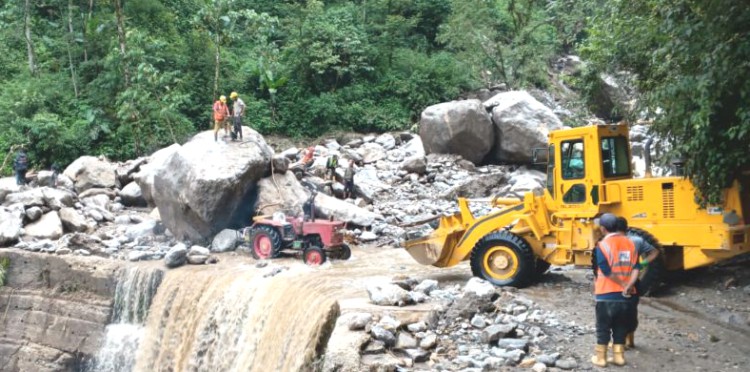
Pic caption: The State government was directed to
formulate a comprehensive climate-resilient road construction framework with
the High Court of Sikkim observing that the recurring deterioration of roads
demands a fundamental review of how roads are planned, designed and built in
the Himalayan terrain of Sikkim.
BOX
8 QUESTIONS ON SIKKIM’S ROADS
The High Court has directed that the report to be
submitted by the State government should indicate:
Existing road standards: Technical
standards currently followed for road construction in Sikkim.
Suitability of standards: Whether these
standards adequately address Sikkim’s geological, geotechnical, climatic,
hydrological and seismic conditions.
Drainage & slope protection:
Standards and methods used for drainage and protection against landslides,
erosion and slope failures.
Quality control: Existing
quality-control and third-party inspection mechanisms for road projects.
Monitoring compliance: How compliance by
contractors and executing agencies is monitored.
Climate resilience: Measures proposed
to ensure climate resilience and long-term sustainability of roads.
Sikkim-specific standards: Whether
additional or Sikkim-specific technical standards need to be prescribed.
Accountability: How
responsibility will be fixed on executing agencies and contractors for
deviations from prescribed technical standards.