


Sunday, Aug 09, 2026 09:00 [IST]
Last Update: Sunday, Aug 09, 2026 03:27 [IST]


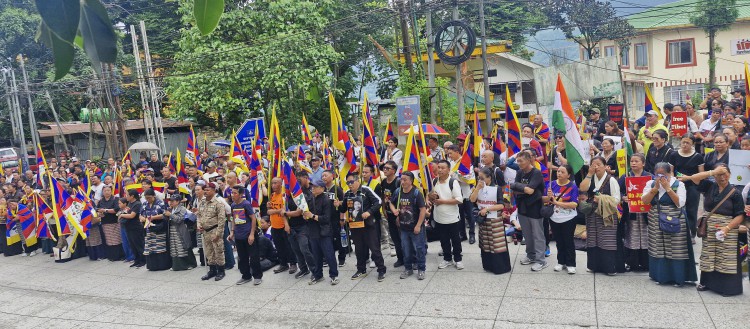
GANGTOK,: Joining a worldwide chain protest in solidarity with martyr Lobga Rangzen and rejecting China’s so called “Ethnic Unity Law”, the Regional Tibetan Youth Congress (RTYC) Gangtok organised a peace rally from Indira Bypass to the District Court in Gangtok on Saturday.
More than 500 members of the RTYC Gangtok and members of the Tibetan community participated in the peaceful rally, which sought to draw attention to the Tibetan community’s concerns over what it described as policies aimed at suppressing Tibetan language, culture, religion and national identity.
Speaking to the media, RTYC Gangtok president Chung Chung Bhutia said the rally was organised in response to the “Law on Promoting Ethnic Unity and Progress”, which China passed on July 1.
“The main objective behind conducting today's rally is that on July 1, China passed a new law, the ‘Law on Promoting Ethnic Unity and Progress’. What that law entails is that in all the regions captured by China, those of us who are classified as minorities are required to abandon our own language and script in favour of China's language and script, even in schools,” Bhutia said.
“But we are not a minority. Our country belongs to us,” he added.
Bhutia also linked Saturday’s protest to the self-immolation of 52-year-old Tibetan activist Lobga Rangzen outside the United Nations headquarters in the United States on July 2. According to the RTYC president, Rangzen took the extreme step in protest against the law and the policies being pursued in Tibet.
“You all know how horrific it is to set one's own body on fire. Think about how much pain we feel from a tiny matchstick burn. He didn't do it lightly,” Bhutia said.
The president said the Tibetan community was particularly concerned by what it described as a lack of response from the international community, including the United Nations, despite the deaths of numerous Tibetans through self-immolation.
“So far, around 160 Tibetans have committed self-immolation. Yet, to this day, the UN hasn't paid any attention to it,” he said.
Bhutia said Tibetans in the United States had continued protests outside the UN headquarters since July 2, but had not received an adequate response.
“We organised this rally today in support of that cause. This was organised by RTYC Gangtok in support of Lobga who self-immolated,” he said.
According to Bhutia, Rangzen had conveyed a message before his death asking fellow Tibetans not to mourn him but to continue the protest he had started. The Gangtok rally was part of a larger international campaign being coordinated by the Tibetan Youth Congress (TYC).
Bhutia also announced that around 700 people from Gangtok are expected to travel to Kolkata on August 20 as part of a protest organised by the Gangtok RTYC. The protesters are expected to demonstrate in front of the Chinese Embassy.
Addressing the wider Sikkimese public, Bhutia also appealed to people to use the term “Indo Tibet border” rather than “China border” while referring to the frontier in Sikkim.
“In Gangtok, although the border is up there, I want to make a humble request to all the residents of Sikkim, the general public, brothers, educated citizens, officers, politicians and everyone living here. As a Tibetan, I request you all to remember that the border up there is our Tibet border, the Indo Tibet border. It is not a China border,” she said.
Bhutia argued that the establishment of the Indo Tibetan Border Police reflected the terminology used by the Indian government.
“India itself recognises this by establishing the ITBP, the Indo Tibetan Border Police. If it were a border with China, it wouldn't be called the Indo Tibetan Border Police. So whenever people go up there, please refrain from calling it the China border,” he said.
He also urged members of the public who could not physically participate in the demonstrations to support the campaign through social media.
“Local residents don't necessarily have to join us physically on the streets. Those who joined us today, that is wonderful. But those who cannot come can still support us by sharing and commenting on our protest posts on Facebook, which helps us immensely,” Bhutia said.
Bhutia acknowledged the sensitivity surrounding the border issue and said the organisers were grateful to the Sikkim government for allowing the rally to take place.
“Regarding the border situation, we understand it is sensitive and places a lot of responsibility on the Sikkim government. Even so, the Sikkim government understood our context, treated us as their own, and granted us permission to hold the peace rally today. For that, we express our heartfelt thanks to the Sikkim government,” she said.
The protest in Gangtok forms part of a worldwide chain of protests announced by the Tibetan Youth Congress. According to the TYC statement, the campaign began in Dharamshala and is being extended across the world through its regional chapters and supporters.
The campaign includes hunger strikes, coordinated demonstrations, candlelight vigils, public rallies, awareness campaigns, diplomatic outreach and peaceful direct action in different parts of the world.
A separate rally was also held at Rabongla in South Sikkim on Friday as part of the campaign.
In its statement, the TYC strongly rejected what it described as the Chinese government’s so called “Ethnic Unity Law”, arguing that the legislation was not about ethnic unity but was instead intended to accelerate the assimilation of nations and communities living under Chinese rule, including Tibet, East Turkistan, Southern Mongolia and Manchuria.
“Behind the language of ethnic unity lies an agenda of unilateral control,” the TYC said, alleging that policies were being used to assimilate Tibetans through political domination and to suppress distinct national identities.
The statement alleged that policies attributed to the Chinese government seek to suppress Tibetan languages, undermine religious institutions, rewrite history, destroy cultural heritage and separate children from their communities through state run boarding schools. It further accused the Chinese authorities of attempting to replace distinct identities with loyalty to the Chinese Communist Party.
The TYC has put forward a series of demands addressed to the Chinese government, the United Nations and the international community.
The organisation called on the United Nations to formally respond to Rangzen’s self-immolation, which occurred outside the UN headquarters, and to address what it described as the grave human rights situation in Tibet and the circumstances that led to his death.
It also demanded accountability for policies and repression that it says have driven Rangzen and numerous other Tibetans to self-immolation.
The TYC further called on the international community to recognise what it describes as Tibet’s historical status and support the Tibetan people’s right to restore their freedom and independence.
It demanded the immediate repeal of the so called “Ethnic Unity and Progress Law”, describing it as an instrument of forced assimilation, and called for an end to its implementation in Tibet.
The organisation also demanded the immediate and unconditional release of political prisoners, including the 11th Panchen Lama, whom it described as the world’s youngest Tibetan political prisoner, as well as Tibetan environmental activists, artists, human rights defenders and others it considers political prisoners.
“A government cannot legislate away the identity of a nation. A policy aimed at erasing people's language, culture, history, and spiritual heritage is not unity, it is a state enforced assimilation,” the TYC said.
The organisation also criticised a recent statement attributed to UN Secretary General spokesperson Stéphane Dujarric referring to Tibet as a “minority”.
The TYC described the characterisation as historically inaccurate and politically incorrect, arguing that it reinforced what it called the Chinese Communist Party’s narrative.
“Tibet is not a minority of China. It is an occupied nation,” the statement said, adding that referring to Tibet as a minority undermines Tibetan national identity and the Tibetan people's demand for freedom and independence.
The TYC called on the United Nations to uphold truth and impartiality and not use terminology that, in its view, legitimises China's control over Tibet or contributes to the erasure of Tibetan national identity.
The organisation said the death of Lobga Rangzen should not mark the end of the movement but should instead become a renewed call for resistance, solidarity and international action.
“The sacrifice of Martyr Lobga Rangzen is not the end of our struggle, it is a renewed call for resistance, solidarity, and international action,” the statement read.
It described Rangzen’s sacrifice as a symbol of what it called the continuing spirit of the Tibetan people and said his message would continue through the movement’s protests and campaigns.
The statement concluded with the declaration: “Tibet was a nation. Tibet remains a nation. Tibet shall be free.”