





Saturday, Jun 20, 2026 09:15 [IST]
Last Update: Saturday, Jun 20, 2026 03:38 [IST]


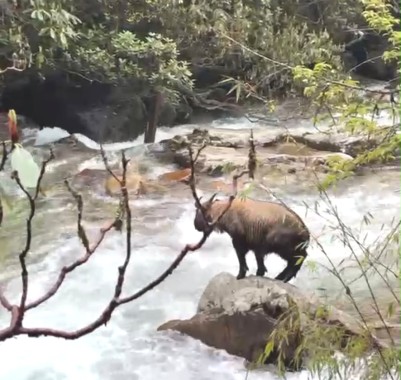
GANGTOK,: Nearly 27 years after the Himalayan Takin (Budorcas taxicolor) was first
documented in Sikkim, a herd of the species has been sighted once again in the
Bakuchen area under Tingda Reserve Forest in North Sikkim (Mangan district).
The sighting
took place on June 14 during a joint inspection and patrolling exercise carried
out by officials from the Forest and Environment department and the State
Tourism department. A herd of eight takins was captured on video for the first
time in the State, marking a major milestone in Sikkim’s wildlife conservation
history.
The footage was
recorded by Tsewang Nedup Bhutia (Maggie), Head Forest Guard under the Phodong
Territorial Range, who was part of a survey team assessing a proposed trekking
route between Kabi and Panch Pokhari in North Sikkim.
The Himalayan
takin, a large and robust goat-antelope found in the rugged valleys and alpine
regions of the eastern Himalayas, is known for its distinctive appearance,
often described as a mix between a cow and a goat. It is also the national
animal of Bhutan. The species is listed as Vulnerable on the IUCN Red List due
to threats such as habitat loss, deforestation, and hunting.
This latest
sighting holds particular importance as it represents not only the first-ever
video documentation of the species in Sikkim but also the largest herd recorded
in the State so far. No previous visual record exists of such a large group.
Recalling the
encounter, Bhutia said the team had been conducting a survey from June 13 as
part of trekking trials in the region. “On June 14, while travelling between
Dalapchand and Bakuchen, we noticed a pungent smell in the air, which usually
indicates the presence of a wild animal nearby. I asked our guide to slow down,
and at around 1:39 pm, we spotted the animals on the left side of the Ratey
Chhu River,” he said.
“I immediately
identified them as takins, which are known as the national animal of Bhutan. I
informed the team that this was the first sighting of the species in the wild
in Sikkim. There were eight individuals in the herd. As soon as they noticed
us, they rushed towards the river. I managed to capture only four on camera, as
the others had already crossed. The entire sighting lasted around 25 seconds
before they disappeared into the forest,” he added.
Bhutia said the
team waited in the area for another 10 to 15 minutes but could not locate the
animals again. “It was an emotional moment for me to witness such a rare
species with my own eyes for the first time in Sikkim,” he said.
He further
noted that the animals were likely grazing in the area at the time and
reiterated that the pungent smell is often a sign of nearby wildlife.
According to
Bhutia, while he recorded the initial footage, Kazi Sherpa, joint director of
the State Tourism Department, later captured additional visuals, including
footage of Bhutia himself. Sherpa initially mistook the animals for blue sheep
before they were correctly identified as takins.
Sikkim's first
documented record of the Himalayan Takin dates back to June 16, 1999, when the
animal was first sighted by Bishnu Kumar Sharma, then supervisor of Kyongnosla
Alpine Sanctuary in East Sikkim. The sighting was subsequently photographed and
documented by late Chezung Lachungpa, then District Forest Officer (Wildlife).
The record was later published in the Journal of the Bombay Natural History
Society in 2000 as evidence of a westward range extension of the species.
Recounting the
first sighting on June 16, 1999, Bishnu Kumar Sharma, then supervisor at
Kyongnosla Alpine Sanctuary (Wildlife), said he initially had no idea what a
Himalayan Takin was.
“People came to
me saying that an animal had appeared and described it as a sheep. I went down
past Tsongmo, below the shops at 17th Mile, where there is a steep stream
called Rongchu. The animal was on the other side of the Rongchu bridge. I
rushed there with two or three watchmen. When we reached, we realised this was
not a sheep but something entirely different. Since I didn’t know what it was,
I returned to the Traffic Control Post. We didn’t have mobile phones then, so I
used the Army’s phone to inform the then DFO (Wildlife East), the late Chezung
Lachungpa,” said Bishnu to SIKKIM EXPRESS.
Sharma said he
first sent a message through the police reporting an unknown animal near
Rongchu bridge and later spoke to Lachungpa, who assured him he would visit the
next morning.
“He arrived
around 7 am. It had been snowing heavily, but around 10 or 10:30 am, when the
sun came out, the animal emerged slowly from the forest and walked towards the
bridge. It was quite large,” Sharma recalled.
“As soon as
Lachungpa saw it, he got very excited and said, ‘This is the national animal of
Bhutan, a Takin.’ He mentioned there had been informal reports earlier, but no
official sighting.”
Lachungpa then
photographed the animal, marking the first documented record of the species in
Sikkim. “He later gave me a certificate, and the incident was also reported in
newspapers,” Sharma said.
However, about
15 to 20 days later, the animal moved towards the 4th Mile area and began
staying near a sheep shed. “It befriended the sheep there and started staying
in the shed. One day, it attacked the owner and killed him. After roaming in
the area for some time, it disappeared and was never seen again,” he said.
Referring to
the recent sighting of a herd of eight takins, Sharma said, “At that time, we
saw only one male takin. Now, eight takins sightings after so many years shows
that forest protection and conservation efforts have improved. These animals
are not being disturbed.”
He believes the
herd likely migrated from Bhutan through the Pangolakha range. “They must have
entered through adjoining forests and moved deep inside the sanctuary. These
are dense, undisturbed areas with very little human presence.”
Sharma added
that the animals may have been in the region for months without being detected.
“We do not regularly patrol the deepest forest areas, so it is possible they
arrived earlier and gradually moved here. Researchers now need to understand
how a herd of eight migrated together.”
Drawing a
parallel with past wildlife movement, he noted that species often travel long
distances through forest corridors. “Just like tigers have been known to
migrate across regions, these animals may also be using connected habitats to
move,” he said.
He emphasised
the importance of both research and field patrolling. “The deep forest areas
remain largely undisturbed, which is why such species can survive. Protecting
these habitats is crucial,” he said.