





Sunday, Jul 05, 2026 23:00 [IST]
Last Update: Saturday, Jul 04, 2026 17:25 [IST]


GANGTOK,:
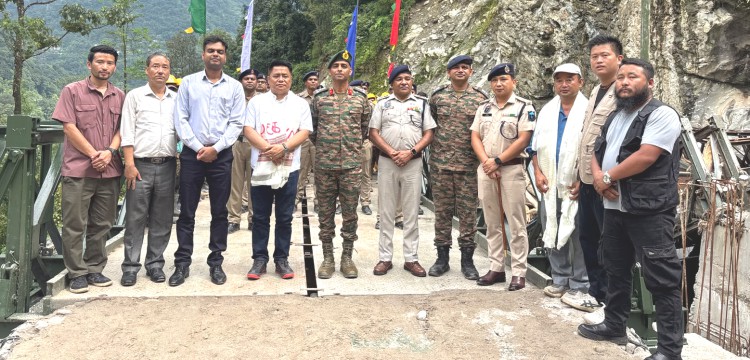
The Border Roads Organisation (BRO) restored the Bailey Bridge over Phee Chu
(Phee Khola) near Phidang within five days after it was washed away by
landslide triggered by heavy rainfall on June 28, restoring a crucial road link
to Lower Dzongu and North Sikkim.
The
bridge was inaugurated on Saturday by Forest minister and area MLA Pintso
Namgyal Lepcha, who described the achievement as an example of swift
coordination between the district administration and BRO.
“The
temporary bridge over Phee Chu was damaged on Sunday night due to heavy
rainfall. As a result, connectivity was completely cut off," Lepcha said. "Despite
this, BRO made remarkable efforts and assured us that the Bailey Bridge would
be restored within two to three days. They have fulfilled that commitment
exactly as promised. Today, we have formally inaugurated the bridge and
officially reopened this vital connectivity."
Expressing
gratitude on behalf of the people of North Sikkim, the minister said, "On
behalf of the Government of Sikkim and the people of this area, I extend my
heartfelt congratulations and sincere gratitude to BRO. Their dedication and
efficiency deserve immense appreciation."
He
added that the government hoped the same level of commitment would continue
during future disasters.
"We
hope that whenever disasters cause damage in the future - whether bridges are
washed away or roads are blocked - work can be carried out with the same speed
and commitment so that connectivity is restored quickly."
Highlighting
the importance of the route, Lepcha said the bridge collapse had affected
nearly seven Gram Panchayat Units (GPUs).
"This
bridge provides access towards Phidang, Sangkalang, Dzongu, and onward routes
leading to Chungthang, Lachen, Lachung and Dongkya La. The DSM Road plays a
vital role whenever the main highway is blocked, which is why restoring this
bridge was so crucial."
He
also credited the district administration for continuously monitoring the
situation. "Our district collector personally visited the site several
times. Because of the coordinated efforts of all departments and agencies, we
have successfully reopened this bridge."
Mangan
DC Anant Jain said the existing preparations for a permanent bridge
significantly accelerated restoration efforts.
"The
Phee Chu bridge collapsed on June 28 following extremely heavy rainfall. The
force of the water caused the bridge to fail," Jain said.
"The
very next day, officials from the district administration, BRO, the police and
I personally visited the site. Fortunately, the abutments and concrete
foundations for a permanent bridge had already been constructed. BRO
immediately coordinated with its Regional Construction Centre, arranged all the
required bridge components within a day, and within two to three days
successfully launched the Bailey Bridge."
Clarifying
the impact on nearby villages, Jain said, "Only Lum and a few adjoining
villages were temporarily cut off. Lower Dzongu could still be accessed through
the Sangkalang route."
On
monsoon preparedness, he said the district administration had already mapped
alternative routes and maintained updated inventories of machinery and bridge
components.
"When
this bridge collapsed, BRO already knew where the required bridge materials
were available. Such advance planning enables us to respond rapidly whenever
natural disasters occur."
Providing
an update on road connectivity across North Sikkim, Jain said, "Most roads
in Mangan district have now been restored. Dzongu is accessible through the
Phidang-Sangkalang Road and Lachung through the Tingvong Road. Lachen remains
inaccessible through the main road near Taram Chu, but vehicles can reach it
through the longer Dongkyala route. BRO expects to restore the damaged stretch
by around July 15 to 20."
Project
Swastik chief engineer Brigadier Amit Sakhre said the unprecedented rise in the
water level of Phee Chu completely destroyed the temporary Bailey Bridge.
"We
immediately initiated action by mobilising our bridge stores, equipment and
personnel. Despite continuous rain and difficult conditions, we completed the
launch of this Bailey Bridge within the last five days," he said.
"The
reopening of this bridge will bring significant relief to the residents of
Dzongu who had lost road connectivity. It will also ensure the smooth movement
of Indian Army convoys through this route."
Sakhre
also highlighted BRO's broader restoration work.
"The
Sangkalang Road had suffered extensive landslides and formation cuts due to
heavy rainfall. Within one to one-and-a-half months we restored it for light
vehicles, and yesterday we also opened it for heavy vehicles."
On
the permanent bridge project, he said the newly inaugurated Bailey Bridge would
serve only as an interim arrangement.
"The
bridge that collapsed was constructed around two years ago as a temporary
Bailey Bridge. A permanent bridge was already under construction here, and its
substructure has been completed. The permanent bridge alignment is much farther
away from the Phee Chu, making it far less vulnerable to flood damage."
"Our
immediate priority was to restore connectivity. Once the monsoon subsides, we
plan to begin launching the permanent bridge from October," Sakhre added.