





Friday, Jul 03, 2026 22:30 [IST]
Last Update: Thursday, Jul 02, 2026 16:54 [IST]


GANGTOK, (PIB): In a significant stride towards technology-enabled disaster
preparedness in the Himalayas, Centre for Development of Advanced Computing
(C-DAC) under the Ministry of Electronics & Information Technology (MeitY),
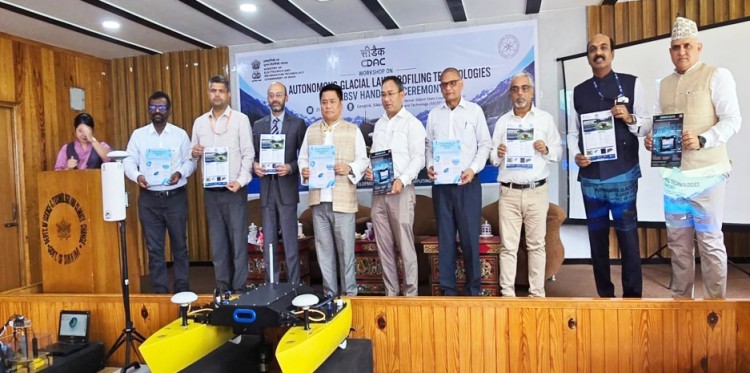
Government of India, on June 25, handed over an indigenously developed Glacial
Lake monitoring technology suite to DST, Government of Sikkim.
The
ceremony, held at the Sikkim State Council of Science and Technology (SSCST),
Gangtok, was presided over by Pintso Namgyal Lepcha, Minister for Science &
Technology, Government of Sikkim, as chief guest, in the presence of senior
officials from MeitY, C-DAC, and DST Sikkim.
The
handover marks the culmination of sustained R&D effort to address critical
climate-induced hazards facing the Indian Himalayan region - Glacial Lake
Outburst Floods (GLOFs). Sikkim alone hosts approximately 320 glacial lakes, 14
of which have been identified as high-risk.
The
handover was part of a day-long Workshop on Autonomous Glacial Lake Profiling
Technologies that brought together scientists, engineers, and policymakers to
deliberate on autonomous survey technologies, IoT-driven early warning systems,
and high-altitude bathymetry. The workshop featured technical presentations and
a panel discussion on GLOF preparedness and field perspectives. The event
concluded with a hands-on training session by C-DAC on the NiyanthriQ and AGLP
software platforms, equipping DST Sikkim's team for independent field
deployment.
The
ABSV-AGLP suite is an indigenous platform developed aligning with Atmanirbhar
Bharat initiative. By placing an advanced, end-to-end autonomous GLOF risk assessment
capability directly in State’s hands, MeitY and C-DAC have demonstrated that
central scientific institutions can be powerful enablers of climate resilience
at the subnational level — building indigenous capacity where it is needed
most. The developed state of the art system is cost effective and at par with
the available foreign solutions.
With
this transfer, Sikkim becomes the first State in India to independently operate
an end-to-end indigenous autonomous Glacial Lake profiling and risk assessment
capability. The ceremony was attended by Dr. Sandeep Tambe, Principal
Secretary, DST, Govt. of Sikkim; Dhiren Shrestha, Principal Director/Secretary,
DST, Govt. of Sikkim; Dr. D. D. Ray, Outstanding Scientist (Retd.), BARC and
senior representatives from MeitY, C-DAC, and the Government of Sikkim.