





Saturday, Jun 13, 2026 23:15 [IST]
Last Update: Friday, Jun 12, 2026 17:46 [IST]


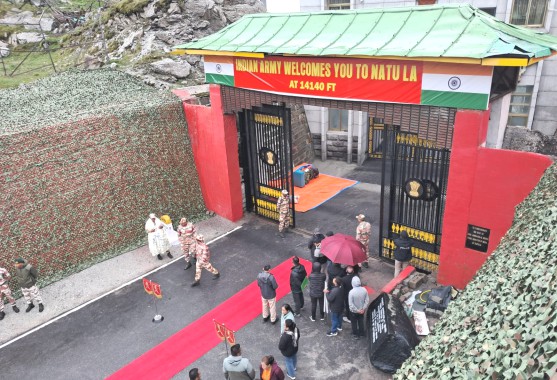
GANGTOK,: Preparations for the 2026 Kailash Mansarovar Yatra through the Nathu La
route are underway, with the first batch of pilgrims expected to arrive in
Sikkim on June 15 before crossing into the Tibet Autonomous Region (TAR) of
China on June 20.
Speaking
to the media, Sikkim Tourism Development Corporation (STDC) chairman Lukendra
Rasaily said the first batch of pilgrims reported in New Delhi on June 11 and
is currently undergoing mandatory medical examinations, fitness assessments,
visa processing and other formalities coordinated by the Ministry of External
Affairs (MEA).
“The
first batch has already started its journey. Pilgrims have reported in Delhi
and are undergoing rigorous medical tests and documentation procedures. They
are expected to arrive in Gangtok on June 15 and will cross over into the Tibet
Autonomous Region through Nathula on June 20,” Rasaily said.
The
Kailash Mansarovar Yatra through Nathula Pass was introduced in 2015 by the
Ministry of External Affairs in coordination with the Government of Sikkim.
STDC, a State government undertaking, has been designated as the nodal agency
responsible for conducting and managing the pilgrimage on the Indian side.
This
year, 10 batches comprising 50 pilgrims each have been allotted for the Nathula
route, taking the total number of yatris to 500. The final batch is expected to
commence its journey in August.
According
to Rasaily, around 1,500 applicants from across India had applied for the
pilgrimage through Nathula this year, but only 500 were selected through a
computerized lottery conducted by the Ministry of External Affairs.
After
arriving in Gangtok, pilgrims will spend several days acclimatizing before
entering Tibet. The itinerary includes a two-night stay at the First
Acclimatization Centre at 18th Mile, located at an altitude of approximately
10,500 feet. They will then move to the Second Acclimatization Centre at Hangu
Lake, situated at about 13,000 feet, for another two-night stay.
During
this period, pilgrims will undergo local acclimatization exercises, visit
Tsomgo Lake and Baba Harbhajan Singh Mandir, and undergo a final medical
examination by the Indo-Tibetan Border Police (ITBP) medical team.
Following
customs, immigration and security formalities at Nathula Pass, which stands at
an altitude of 14,140 feet, the pilgrims will enter Tibet. Their journey
through the Tibetan plateau will take them through Kangma (Kangmar), Lazi
(Lhatse), Zhongba (Drongpa) and Darchen, the gateway town to Mount Kailash.
From Darchen, they will proceed to Deraphuk (Dirapuk) and Zunzhui Pu
(Zuthulpuk), important halts during the sacred Kailash Parikrama or Kora. After
completing the pilgrimage, they will return through Qugu, Zhongba, Lazi and
Kangma before re-entering India through Nathula.
The
entire pilgrimage from Delhi to Delhi spans 22 days. Pilgrims spend four days
in Delhi completing documentation and medical procedures, several days in
Sikkim for acclimatization, and approximately 12 days on the Tibetan plateau.
Much of the journey in Tibet takes place at elevations ranging between 12,000
and 14,000 feet.
Rasaily
said the State government has upgraded facilities at the acclimatization
centres following lessons learned during last year's resumption of the
pilgrimage. The Kailash Mansarovar Yatra had remained suspended for several
years due to the COVID-19 pandemic and other disruptions before resuming in
2025.
"Last
year we were effectively starting from the beginning after a long gap. This
year we are more experienced and better prepared. The Hon'ble Chief Minister
has directed that the Kailash Mansarovar Yatra be conducted to the highest
standards," he said.
He
added that accommodation and infrastructure at the acclimatization centres have
been strengthened, while internet and telephone connectivity have also been
improved. Medical teams will remain stationed at the camps to monitor pilgrims'
health and assist those experiencing altitude-related ailments.
Officials
from the Ministry of External Affairs, ITBP, the Ministry of Ayush and various
departments of the Government of Sikkim will be involved in supporting the
pilgrimage.
Under
the logistical arrangements managed by STDC, pilgrims travel by air between
Delhi and Bagdogra before being transported by SNT buses to Gangtok, the
acclimatization centres and Nathula Pass. Dedicated vehicles are used for
transporting luggage, while each batch is accompanied by two liaison officers
and a medical doctor. After crossing Nathula, pilgrims are transported by
air-conditioned buses provided on the Chinese side for onward travel to
Mansarovar and other designated destinations.
The
cost of undertaking the pilgrimage through the Nathu Lla route is approximately
Rs 65,000
on the Indian side, which includes a registration fee of Rs
5,000, airfare
between Delhi and Bagdogra costing Rs 21,000 and STDC charges of Rs
39,000 covering
accommodation, transportation, catering and logistical support. On the Chinese
side, pilgrims are required to pay US$2,700 towards immigration, accommodation
and transportation expenses, along with RMB 3,360 for porters and ponies.
The
Kailash Mansarovar Yatra is regarded as one of the most sacred pilgrimages for
Hindus, Buddhists, Jains and followers of the Bon faith. Besides its spiritual
significance, the pilgrimage is also viewed as an important confidence-building
and people-to-people exchange initiative between India and China, with the
Nathu La route serving as a key gateway through Sikkim.