


Wednesday, Feb 25, 2026 22:00 [IST]
Last Update: Tuesday, Feb 24, 2026 16:29 [IST]


NEW
DELHI, (IANS):
A multi-billion rupee Nepal project, a part of China's ambitious Belt and Road
Initiative (BRI) has been dropped from election pledges by former Kathmandu
Mayor Balen Shah, who is contesting against former Prime Minister K.P. Sharma
Oli in the latter's bastion of Jhapa-5 constituency, reports said.
Parliamentary
election is scheduled in Nepal on March 5 under an interim government, which
was constituted after the resignation of the Oli government facing widespread
Gen Z anti-corruption protests in September last year.
The
Damak Industrial Park in Jhapa, renamed Nepal-China Friendship Industrial Park,
is now in spotlight after Balen's decision, according to the Kathmandu Post.
Quoting
unnamed government officials, the Kathmandu Post said that it was of New
Delhi's concern that the project is located near the Nepal-India border,
particularly the sensitive Siliguri Corridor or "chicken's neck".
Officials
also wondered why Kathmandu was permitting Beijing build such a big project
near the border, saying that the issue has now become sensitive for several
other reasons as well.
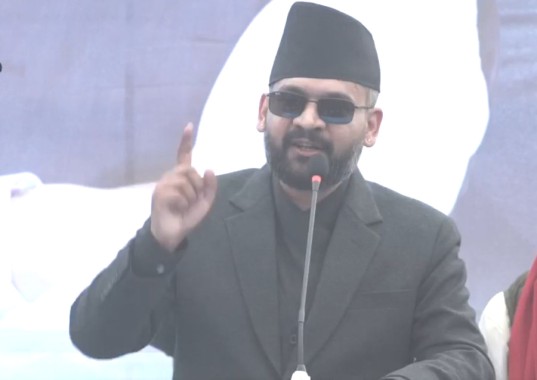
Balen
Shah was among Gen Z's popular choice as the Nepal's interim Prime Minister,
but he excused himself.
The
35-year-old engineer-rapper-turned-politician with a strong youth appeal,
representing the Rastriya Swatantra Party (RSP), is being projected as the
future Prime Minister of Nepal.
"The
project is part of the Belt and Road Initiative (BRI), an ambitious
multi-continent infrastructure programme initiated by Chinese President Xi
Jinping. In February 2021, former Nepal PM Oli laid the foundation stone of the
project in the (Jhapa) district's Kamal Rural Municipality," the newspaper
report added.
Oli, as
the Chairman of the Communist Party of Nepal (Unified Marxist Leninist),
reportedly shared close ties with Beijing.
"While
the former Prime Minister has listed the construction and completion of the
industrial park in his 41-point "commitment paper" released last
week, Balen Shah has omitted the project from his manifesto unveiled on
Monday," the report said.
"We
know about the project and the controversy around it, so we decided to exclude
it," it quoted an unnamed aide of Balen Shah.
Earlier
reports had said that the Nepali Congress and the Communist Party of
Nepal-Unified Marxist Leninist had differed on Kathmandu availing loans.
These
also pointed to significant delays in the implementation of many BRI projects,
with none yet finalised, raising concerns about the effectiveness of the
initiative.
There
has been concern among sections in Nepal, who expressed caution regarding the
financial implications of BRI projects, particularly in light of Sri Lanka's
financial difficulties linked to similar Chinese investments.
"According
to those privy to negotiations, originally, China had proposed several funding
modalities ranging from blended financing models to commercial loans. Nepali
Congress had been insistent that it would not be taking commercial loans under
BRI, but the final agreement adopted the phrase 'aid financing modalities' in
place of the 'grant financing modalities' insisted upon by the Nepali Congress
Party," a document released last year by the think-tank Centre for Social
Innovation and Foreign Policy (CESIF) said.
The
Damak Industrial Park seeks access to the Indian market through the Kakarvitta
and Birgunj ports, it added, highlighting its importance being underscored with
the visit of China's Ambassador to Nepal Zhang Maoming.
According
to the CESIF paper, a significant hurdle for Kathmandu was Beijing's request
for substantial tax exemptions, which Nepal's Finance Ministry then resisted,
since it was not only during the construction phase but also for many years
after the project's completion.
Though
China's demand became a major point of contention, a meeting of the Investment
Board of Nepal, chaired by former Prime Minister Oli, decided to accelerate the
project.
The
report also said that India had communicated that the project constituted a
"red line" and had advised both the Nepali Congress and the Communist
Party of Nepal-Unified Marxist Leninist not to move ahead.