





Tuesday, Nov 03, 2026 22:00 [IST]
Last Update: Monday, Nov 02, 2026 16:25 [IST]


GANGTOK,: Sikkim witnessed a landmark moment for its emerging Concert
Economy and Creative Economy as ‘Nepathya Live in Sikkim – Let’s Get Loud:
Celebrate Sikkim’ drew a full-house audience of more than 15,000 people to
Paljor Stadium, Gangtok, on November 1.
The concert
was originally scheduled for 31 October, but adverse weather conditions
required the event to be postponed by one day. Despite the change, visitors who
had travelled from outside Sikkim remained patient, adjusted their travel plans
where necessary and returned to Paljor Stadium on 1 November, contributing to
an extraordinary show of audience commitment and cooperation.
According to
post-event audience figures compiled by the organisers, approximately 4,652
people travelled from outside Sikkim, while more than 10,348 attendees were
from within the State.
The audience
represented 19 Indian States, 2 Union Territories and 6 countries, making the
concert a significant example of people travelling specifically to Sikkim for a
large-scale cultural and musical experience.
Chief Minister
Prem Singh Tamang (Golay) has on several public occasions spoken about the
potential of the Concert Economy and Creative Economy, and about culture,
tourism, creativity and youth-led opportunities contributing to the State’s
future.
For PVE
Network, those statements became an important source of inspiration behind the
initiative.
The movement
surrounding the Nepathya concert provided a visible example of that idea in
practice. Thousands of visitors travelled to Gangtok, stayed in hotels and
homestays, used taxis and other local transport, visited restaurants and cafés,
shopped in local markets and experienced Sikkim beyond the concert venue.
The one-day
postponement also meant that many travelling audiences extended or rearranged
their stay, further contributing to activity across the hospitality, transport
and food sectors.
Nepathya
Delivers a Memorable Stadium Performance
At the heart
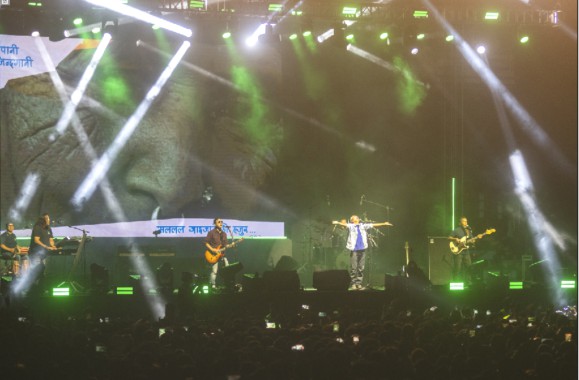
of the evening was a powerful performance by Nepathya, led by frontman Amrit
Gurung, who kept the packed Paljor Stadium engaged throughout the night. The
band’s distinctive blend of Nepali folk traditions and rock music created a
remarkable atmosphere as thousands sang and celebrated together.
The evening
drew from the musical identity that has made Nepathya one of the most
recognised Nepali bands across generations, with much-loved songs including
“Resham,” “Jomsomai Bazaarma,” “Bhedako Oon Jasto,” “Chhekyo Chhekyo” and “Taal
Ko Pani” among the songs associated with the band’s enduring popularity.
The sight and
sound of thousands of people celebrating Nepali music inside an open-air
stadium in India became one of the defining images of the evening.
Based on PVE
Network’s review of available historical records, the organisers describe the
Paljor Stadium concert as the first full-house open-air stadium performance by
a Nepali band outside Nepal.
The
achievement adds another significant milestone to Nepathya’s long international
journey and demonstrates the ability of Nepali-language music and Himalayan
culture to attract stadium-scale audiences beyond Nepal.
Bikesh
Kayastha, Founding Director of PVE Network and Head of Event, said: “The
Hon’ble Chief Minister’s speeches on the Concert Economy and Creative Economy
inspired us to follow this direction. We wanted to demonstrate Sikkim’s
potential as a cultural and emerging musical tourism destination, and what
happened at Paljor Stadium has shown that the opportunity is real.”
“A full
stadium and 4,652 visitors from outside Sikkim send a strong message to
organisers across India and abroad that Sikkim is ready for major live
experiences. I believe this will inspire many more event companies to consider
Sikkim.”
The successful
execution of an event of this scale was made possible through coordination
between multiple stakeholders.
The event was
held under the patronage of Chief Patron Sanjeet Kharel, with Tenzing Dorjee
Bhutia serving as Chief Coordinator.
Throughout the
preparation period, the organising team worked closely with the administration,
police, concerned government departments, venue authorities, production teams,
partners and local stakeholders on crowd movement, traffic, security, venue
operations and public convenience.
The
coordination was particularly important following the weather-related
postponement, when arrangements had to be adjusted within a limited period
before the rescheduled concert on 1 November.
A Signal to
the Live-Event Industry
A full-house
stadium concert in Gangtok sends a wider message to promoters, artists, event
companies and creative businesses across India and internationally.
Sikkim
possesses a combination of natural beauty, cultural identity, hospitality and
destination appeal that can support major cultural experiences.
More events of
scale have the potential to create opportunities across hotels and homestays,
restaurants and cafés, transport operators, local shops and vendors, production
and technical professionals, artists and content creators, tourism businesses
and young professionals.
The success of
the Paljor Stadium concert can therefore serve as an example for future
organisers considering Sikkim as a destination for major music, cultural and
creative experiences.
Concert
Economy in Real Terms
The message
emerging from the event is straightforward: Music brings people. People create
travel. Travel strengthens tourism. Tourism creates economic movement.
The packed
Paljor Stadium demonstrated that people are willing to travel significant
distances for the right cultural experience. The movement of 4,652 visitors
from outside Sikkim, combined with a total audience exceeding 15,000, provided
a visible example of how a concert can create activity extending far beyond the
stage.
PVE Network
expressed its sincere gratitude to the Government of Sikkim, concerned
departments and authorities, Chief Patron Sanjeet Kharel, Chief Coordinator
Tenzing Dorjee Bhutia, Sikkim Police, partners, local stakeholders, production
teams, volunteers and the people of Sikkim for their cooperation and support.
A special
acknowledgement was extended to the 4,652 visitors who travelled from outside
Sikkim, particularly those who remained patient and cooperative following the
postponement from October 31 to November 1.
The
organisation also acknowledged the vision articulated by Chief Minister Prem
Singh Tamang (Golay) around the Concert Economy and Creative Economy, which
served as an important inspiration for the initiative, a press release informs.