


Friday, Mar 13, 2026 21:45 [IST]
Last Update: Thursday, Mar 12, 2026 16:07 [IST]


GANGTOK,: Chief Minister Prem Singh Tamang-Golay on Thursday chaired the first
review meeting of the ‘Mero Alaichi Mero Dhan’, a flagship programme of the State
government, at Samman Bhawan here.
The
initiative was launched in October 2024 aiming to revive large cardamom
cultivation in Sikkim with Department of Science & Technology (DST) as the
nodal department.
During
the meeting, the Chief Minister reviewed the progress of the initiative and
appreciated the significant work being undertaken by the Department of Science
and Technology on key issues related to large cardamom cultivation. He
encouraged the team to continue working collectively and adopt innovative
approaches to further strengthen the sector and support farmers, a CMO press
release informs.
On
the occasion, a Mahindra Bolero Camper vehicle was ceremonially handed over to
the DST team to enhance field outreach, monitoring, and extension activities
across cardamom growing areas.
The
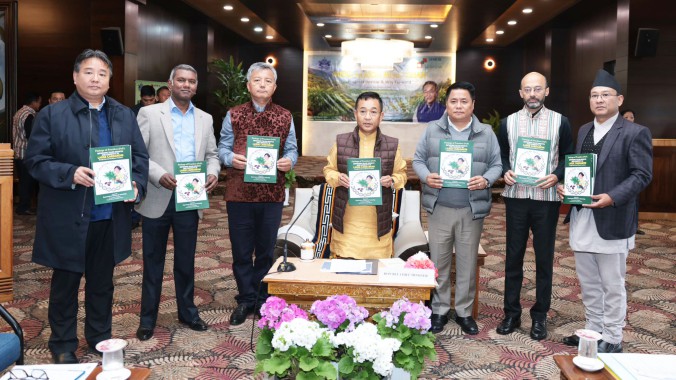
programme also witnessed the release of a package of practices for the control
of blight disease in large cardamom through the innovative application of
Bordeaux mixture, aimed at helping farmers effectively manage the disease
affecting cardamom crops.
As
part of the initiative, tokens were distributed for the establishment of
Krishak Alaichi Prayogshala (Farmers’ Field Labs). Additionally, financial
assistance of Rs 50,000 each was provided to ten progressive farmers
under the Participatory Plant Breeding Programme to support farmer-led
innovation and experimentation in cardamom cultivation, the CMO release
mentions.
The
event also featured experience sharing by farmers, discussions on field-level
challenges, and a presentation on “Science to Policy Suggestions” by DST
principal secretary Dr. Sandeep Tambe.
The
Chief Minister noted that hearing directly from farmers and experts was
encouraging and valuable. He emphasised that their experiences, ideas, and
commitment would continue to guide the government’s efforts in strengthening
the cardamom sector. He reiterated the State government’s commitment to
leveraging science, innovation, and collective community effort to ensure a
stronger and more prosperous future for cardamom farmers and the agricultural
sector of Sikkim, the CMO release mentions.
In
past, Sikkim used to be a major producer of large cardamom with hundreds of
farming families, especially in western and northern regions, dependent on this
cash crop. Over the years, large cardamom has been ravaged by
climate-change-induced diseases that have taken the form of an epidemic,
reducing cultivation by 50 per cent.
Earlier, about 25000 hectares of land were under large cardamom cultivation
but at present, it has declined to about 12500 hectares. Annual production has
dropped to 2500 metric tons from the earlier output of 5152 metric tons.
At
the review meeting, the DST presentation illustrated that fungal leaf blight
disease outbreak largely contributed to decline of large cardamom production in
Sikkim. It has doubled in prevalence over the last 20 years. Two-thirds of the
cases are fatal, not just reducing yields but destroying entire plantations.
Rudimentary
field-level response like uprooting and disposing of the plants are fruitless
as this strategy does not work for a soil-borne fungus.
Labour
shortage, lack of knowledge, sapling quality, and soil fertility also
contributed to the decline. Winter drought was also a major problem for large
cardamom cultivation.
Four
policy suggestions were made which includes taking up cardamom plantations only
in locations with winter water availability is there, and supporting farmers
with sprinkler irrigation.
Soil
testing of cardamom fields by the Agriculture department to check if soils have
turned highly acidic due to high rainfall was also suggested.
For
fungal disease control, field demonstration of Bordo Mix under regulated use
with farmer capacity building was suggested.