


Tuesday, Oct 06, 2026 11:15 [IST]
Last Update: Tuesday, Oct 06, 2026 05:37 [IST]


GANGTOK,: Restoration of the
Himalayan landscape must move beyond plantation targets and adopt a
community-led, landscape-level approach that integrates ecological recovery
with livelihoods, climate resilience and local knowledge, experts said at an
international technical workshop held in Sikkim.
The three-day workshop on “Developing a Strategic Framework and Manual
for Landscape Restoration in the Himalaya” was organised by the Ashoka Trust
for Research in Ecology and the Environment (ATREE) through The Himalaya
Initiative from September 29 to October 1.
The meeting brought together scientists, government forest officials,
researchers, conservation organisations and restoration practitioners from
India, Nepal and Bhutan to develop a strategic framework and operational manual
for landscape restoration across the Himalayan region.
Opening the workshop, Dr. Eklabya Sharma, strategic advisor and director
of The Himalaya Initiative, ATREE, described the Hindu Kush Himalaya as the
“third pole” and the “water tower of Asia”, stressing that restoration should
be viewed as natural infrastructure for climate resilience and a development
vehicle rather than only a conservation intervention.
He called for a shift from short-term, target-driven projects to
long-term landscape-level interventions and emphasised that communities should
be treated as co-owners of restoration efforts rather than merely participants
or beneficiaries.
A key theme of the workshop was the need to move beyond measuring
restoration through the number of trees planted or their initial survival
rates.
Dr. Aditya Pradhan, postdoctoral research associate at ATREE, presented
the organisation's Multifunctional Socioecological Landscape Restoration
Framework, which integrates ecological, social and livelihood considerations.
The proposed framework takes into account the wide variations in
elevation, ecosystems, land-use systems, tenure arrangements and community
needs across the Himalaya. It outlines a five-step decision-support pathway
covering feasibility and land-tenure consent, baseline assessment, nursery
sourcing, site preparation and outplanting, followed by monitoring of
socio-ecological indicators.
Experts said restoration strategies must also recognise traditional
knowledge and local ecological practices.
Dr. Rajesh Joshi of the GB Pant National Institute of Himalayan
Environment said restoration should move from site-specific plantation targets
to landscape-level ecosystem health, with traditional knowledge holders
recognised as custodians.
Prof. Santaram Joshi of North-Eastern Hill University highlighted the
importance of microbial diversity, locally adapted nurseries and farmer
knowledge, while warning that climate change could increase risks from plant
pathogens and emerging diseases.
The workshop also showcased restoration experiences from across the
region.
Munmun Tamang of Red Panda Network Nepal presented a community-led
habitat restoration programme for the endangered red panda, which has restored
142 hectares and planted more than 142,000 seedlings. Survival rates improved
from 44 per cent in 2023 to 78 per cent in 2025 following greater
post-plantation stewardship and monitoring.
From Bhutan, Tashi Yangki of the Bhutan Ecological Society presented the
RESTORE BHUTAN initiative, which aims to restore 50,000 hectares of degraded
forest by 2030 through partnerships involving Conservation International, the
Bhutan Trust Fund and the Bhutanese government.
Participants also discussed restoration initiatives in other parts of
India, including the ASPIRE Project in the Agasthyamalai region and landscape
restoration work in Himachal Pradesh involving communities, women’s groups and
school students.
The proposed operational manual focuses particularly on areas outside
protected zones in the Darjeeling-Sikkim region, including ecological
corridors, abandoned agricultural land and degraded areas. Its application is
intended to cover alpine, riverine and agro-ecosystems as well.
According to ATREE, the initiative has so far restored 193 hectares and
established six community-based nurseries, creating livelihood opportunities
alongside restoration activities.
Participants identified several challenges, including fragmented land
ownership, difficult terrain, transportation constraints, unpredictable
monsoons, inadequate availability of native planting material and withdrawal of
landowners after agreements.
They called for credible community benefit mechanisms, including
non-timber forest products, medicinal plants, local enterprises and
eco-tourism-linked opportunities.
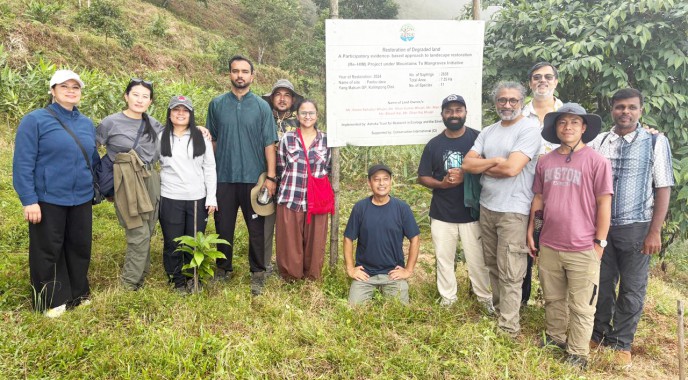
The workshop concluded with a field visit to Panbu and Toplang in
Kalimpong, where participants interacted with communities and observed restoration
activities.
Experts said successful restoration in the Himalaya would require
sustained collaboration among governments, scientific institutions,
conservation organisations, communities, funders and international partners.
The workshop concluded that restoring the Himalaya cannot be achieved
through isolated plantation drives or short-term projects, but requires
long-term systems that combine scientific monitoring with traditional knowledge
and place communities at the centre of landscape stewardship.