


Sunday, Mar 29, 2026 21:45 [IST]
Last Update: Saturday, Mar 28, 2026 16:14 [IST]


GANGTOK,: Sikkim is actively pressing for opening the Indo-Nepal border Chewabhanjyang
in West Sikkim as a second border trade route, complementing the Nathu La
border trade with China in East Sikkim, which is set to resume in June.
The State
government aims to establish similar bilateral trade with Nepal through
Chewabhanjyang multimodal corridor, enhancing regional connectivity and
economic activity. If approved by the Union government, Sikkim would become one
of the few Indian States to have two international land border trade routes –
Nathu La and Chewabhanjyang.
“We
have built the Uttarey-Chewabhanjyang road and further expanded it. We have
been requesting the Centre to open Chewabhanjyang officially for border trade,
and works are going on this regard. Central officials have already visited the
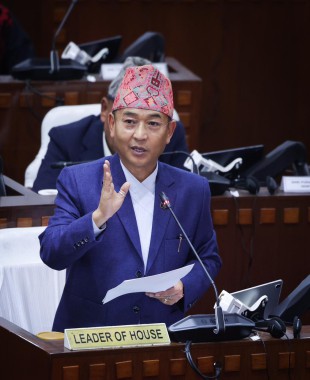
area,” said Chief Minister Prem Singh Tamang Golay. He was addressing the
one-day Sikkim Legislative Assembly session on March 26.
Chewabhanjyang
is the border between India and Nepal in West Sikkim with Uttarey, one the
nearest towns in Sikkim side. The Sikkim government has already established an
18-km road link to Chewabhanjyang from Uttarey. In the Nepal side, a road
already exists from the border connecting to the nearest town Chyangthapu under
Tapleyjung district. Tapleyjhung is about three hours’ drive from
Chewabhanjyang border.
Meanwhile,
the Uttarey-Chewabhanjyang road is to be carpeted during the State-wide road
carpeting mission in 2026-27.
Addressing
the Assembly, the Chief Minister shared that opening Chewabhanjyang route as a
multimodal corridor will increase cross-border trade activities between the two
nations, referring to the Indo-Nepal Treaty of 1950, which allows free movement
of people between the two countries. He said this framework strengthens the
case for developing trade routes such as Chewabhanjyang, which could enhance
both passenger and goods movement.
The
Chief Minister added that Nepal’s capital Kathmandu could be reached in
approximately seven hours via the Chewabhanjyang route, underlining its
potential to transform regional connectivity.
The
Sikkim government has been pressing for a multimodal corridor with a modern
integrated check post between the State of Sikkim and Eastern Nepal through
Chewabhanjyang which has emerged as a crucial point of cultural, economic,
social, tourism and ecological exchanges. It has been a traditional bilateral
contact point between West Sikkim in India and Eastern Nepal.
Opening
Chewabhanjyang as a border trade route would provide a major socio-economic
boost for Sikkim, which is also looking forward to resumption of Nathu La
border trade between India and China.
Golay
informed the House that the border trade between India and China through Nathu
La in East Sikkim would be officially resuming from June. The border trade had
remained closed for six years following Covid-19 pandemic.
During
the discussions in the Assembly, Soreng-Chakung MLA Aditya Golay, while highlighting
cross-border connectivity, also referred to Chewabhanjyang, which falls under
Soreng constituency and is being developed as a multi-modal trade corridor
linking Sikkim with Nepal. He said that trade through the corridor is
“definitely in the loop” and is expected to gain momentum alongside
infrastructure development.
Discussions
on development of border areas of Sikkim also took place in the Assembly
session.
In
his address to the House, Governor Om Prakash Mathur highlighted that special
emphasis is being placed on the development of border villages of Sikkim under
the Vibrant Village Programme, a Centrally Sponsored Scheme aimed at ensuring
that remote border communities are well-connected, self-reliant, and
economically vibrant, while also addressing the challenge of outmigration.
Forty
six villages across Mangan and Gangtok districts have been identified in the
first phase of this initiative launched in 2023. The recently launched second
phase of the Vibrant Village programme further expands its scope to cover
border areas adjoining Nepal and Bhutan. Under this phase, 12 villages across
Pakyong, Soreng, and Gyalshing districts have been identified.
MLA
Aditya Golay raised the issue of extending the second phase of the Vibrant
Villages initiative to border areas of Soreng district, underscoring the
strategic and developmental importance of the region.
Speaking
in the Assembly, Aditya stated he has urged the State government to include
constituencies such as Soreng, Daramdin and Rinchenpong under the programme,
noting that several villages in these areas lie along the India-Nepal border.
He
pointed out that earlier, the Border Area Development Programme (BADP) served
as the primary funding mechanism for such regions, with Soreng district
receiving allocations particularly after 2021. With Phase II of the Vibrant
Village programme now being rolled out, Aditya expressed optimism that more
focused and public-centric development interventions would follow.
However,
he clarified that the exact list of villages to be covered is yet to be
confirmed. “I will have to sit with the concerned department to ascertain which
villages are included, but I am hopeful that my constituency and adjoining
border areas will be considered,” he said.