


Sunday, May 03, 2026 23:15 [IST]
Last Update: Saturday, May 02, 2026 17:39 [IST]


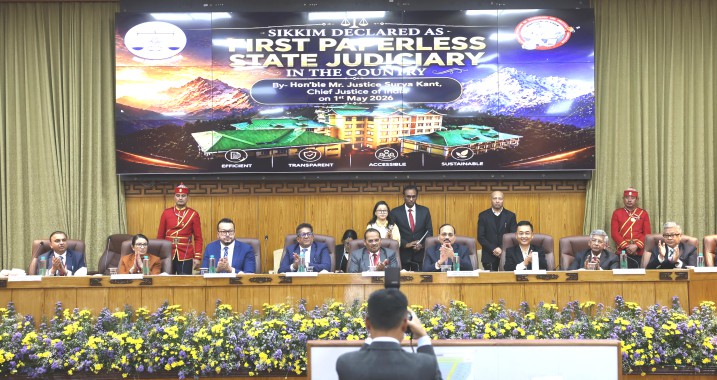
GANGTOK, (IPR): The Conclave on Technology and Judicial Education Conference was
formally inaugurated on May 1 at Chintan Bhawan in the presence of Justice
Surya Kant, Chief Justice of India as the chief guest and Chief Minister Prem
Singh Tamang as guest of honour.
Organised
by High Court of Sikkim in collaboration with eCommittee Supreme Court of
India, the conference shall be held for two days at Chintan Bhawan and Samman
Bhawan to deliberate on the evolving role of technology in strengthening
judicial systems and enhancing legal education.
On
the occasion, Justice Surya Kant, Chief Justice of India officially declared
Sikkim as the first paperless State judiciary in the country.
In
his inaugural address, Chief Justice of India, Supreme Court, Justice Surya
Kant, remarked Gangtok as an ideal venue to host such a significant conclave,
adding that under the majestic presence of Mt Kanchenjunga, ideas too could
rise to great heights. Sikkim’s natural beauty is not merely a backdrop but a
catalyst for inspiration, where the tranquil environment allows space for
reflection and where tradition and progress coexist harmoniously, enabling a
renewed vision of justice, he added.
Reflecting
on the longstanding challenges owing to difficult terrain, the Chief Justice of
India stated that access to courtrooms in such regions had historically been a
test of endurance. This reality is now changing due to improved infrastructure
and, more significantly, due to the growing role of technology in redrawing the
map of access to justice, he stated.
He
highlighted that digital networks were creating new pathways and that the
“digital highway” was connecting citizens directly to judicial forums.
The
Chief Justice of India emphasised that the aspiration was to build a system
where justice no longer required arduous physical travel, and where petitions
could move without necessitating the movement of individuals. In this context,
he stated that the conclave carried deep symbolic significance, as it
reinforced that digital reform was not merely a matter of theory but a
practical necessity for sustaining the rule of law.
Speaking
on the broader national context, he stated that the integration of technology
in the judicial process was aimed at dismantling geographical constraints,
whether arising from difficult terrain, financial limitations, or distance. He
added that such efforts ensured that access to justice was not confined to
urban centres but extended equally to remote regions, including the far-flung
areas of North Sikkim, the Western Ghats, and the Andaman and Nicobar Islands.
He
further added that the Indian legal landscape had undergone a fundamental
transformation and congratulated Justice A. Muhamed Mustaque for this unique
initiative, through which the High Court of Sikkim had achieved the distinction
of becoming the country’s first paperless High Court.
He
stated that the judiciary was steadily moving away from the era of paper-based
systems towards a vibrant digital ecosystem, where initiatives such as the
e-Courts project had redefined the relationship between litigants and the law.
He highlighted the role of judicial data systems in offering real-time insights
into institutional performance and described them as central to monitoring the
health of the justice delivery system.
He
also referred to the growing use of artificial intelligence tools such as
SUPACE and SUVAS, adding that these innovations were acting as force
multipliers by assisting in research, translation, and case management, thereby
reducing the burden of routine tasks on judges. He stated that such
technological advancements allowed judges to focus more deeply on the
complexities of law, thereby enhancing the quality of judicial work. He added
that the true measure of these reforms lay in their accessibility, as they
enabled litigants, even in the most remote parts of the country, to track case
progress, access orders, and engage with legal processes without
intermediaries.
Highlighting
the importance of transparency, he remarked that real-time updates and virtual
hearings were transforming courtroom dynamics and contributing to greater
efficiency and accountability. However, he cautioned that despite significant
progress, the journey towards full digitisation remained ongoing and required
sustained effort.
Outlining
future priorities, he stressed the need for stronger standardisation across
judicial systems, particularly through the implementation of the National Court
Case Information System (NCCIS). He stated that recent developments indicated a
positive shift in the adoption of such systems by High Courts and emphasised
that a balance between uniform national standards and local flexibility was
essential.
He
also highlighted the importance of expanding e-Seva Kendras, describing them as
crucial links between the complexity of the legal system and the immediate
needs of citizens, especially in a country with varying levels of digital
literacy. He added that the existing network of kendras already reflected a
strong national infrastructure and called for further strengthening of their
technical capacity to ensure inclusivity.
Speaking
on the role of artificial intelligence, he highlighted its potential
application at the trial court level, particularly in areas such as preliminary
verification, case management, and identification of patterns in judicial
decisions. He observed that such tools could help reduce delays, minimise
frivolous litigation, and promote consistency in areas such as sentencing and
bail practices.
The
Chief Justice of India further said that while consistency was essential for
predictability and efficiency, it must be achieved without compromising
judicial independence. He stated that technological tools could assist courts
in identifying disparities and moving towards more coherent decision-making
processes.
Stressing
that the adoption of technology must be accompanied by a corresponding shift in
legal education, the Chief Justice of India said that modern judicial training
must go beyond basic digital literacy and include a deeper understanding of
artificial intelligence systems and their interaction with foundational legal
principles such as natural justice. He emphasised the importance of ethics in
this transition, adding that judges must remain vigilant in identifying
potential biases in algorithmic systems and ensure that technology is
strengthened, rather than undermined with regards to the core values of
justice. He added that judicial education must equip future jurists with the
ability to critically engage with technological tools while maintaining control
over their application.
Concluding
his address, he congratulated the Chief Justice of the High Court of Sikkim,
along with all stakeholders including the State government led by Chief
Minister Prem Singh Tamang for achieving the milestone of a paperless High
Court and for placing Sikkim on the national map of judicial innovation.
He
expressed hope that the conclave would provide a roadmap that was both
progressive and compassionate, and commended all participants for contributing
to a mission aimed at ensuring that justice remained accessible, transparent,
and future-ready.
Chief
Minister Prem Singh Tamang attended the programme as the guest of honour and
delivered the executive address, reaffirming the State government’s commitment
to supporting judicial reforms and digital governance initiatives.
In
his address he extended warm greetings to all dignitaries on the auspicious
occasion of Buddha Purnima and International Labour Day, highlighting the
values of compassion, harmony, and dignity of labour.
Welcoming
the distinguished gathering, including the Chief Justice of India and judges of
the Supreme Court of India and High Court of Sikkim, as well as international
delegates, he described the hosting of the conclave in Sikkim during the Golden
Jubilee year of Statehood as a matter of pride and honour for the State.
The
Chief Minister emphasised that the judiciary plays a vital role in safeguarding
the rights and dignity of citizens, particularly the working class, and noted
that the integration of technology into the justice delivery system is both
timely and essential in the digital era.
Highlighting
the State government’s commitment to good governance and innovation, he stated
that Sikkim is actively supporting initiatives aimed at strengthening judicial
infrastructure, expanding access to courts in remote areas, and promoting legal
awareness through institutional mechanisms.
He
further underscored the importance of ensuring that technological progress
remains inclusive, cautioning that no citizen should be left behind due to lack
of access or digital literacy.
The
Chief Minister expressed confidence that the deliberations of the conclave
would contribute significantly towards building a modern, responsive, and
citizen centric judicial system. Describing the declaration of Sikkim as a
paperless judiciary as a historic milestone, he congratulated the judiciary for
this achievement and noted that it would set an example for the rest of the
country. He also highlighted the importance of global collaboration, stating
that the presence of international delegates would enrich discussions and
strengthen shared learning.
Concluding
his address, the Chief Minister expressed gratitude to all dignitaries for
their presence and wished the conclave success, expressing hope that it would
pave the way for meaningful reforms and advancements in the justice delivery
system.
Earlier
the session commenced with opening remarks by Justice Bhaskar Raj Pradhan,
Judge of the High Court of Sikkim and Chairman of the Computer Committee and
Sikkim Judicial Academy, who underscored the growing importance of technology
in strengthening the justice delivery system. He stated that while digital
initiatives such as the e-Courts Mission Mode Project and virtual court systems
have significantly improved efficiency and access, the integration of
artificial intelligence must be approached with caution and guided by
constitutional principles. Emphasising that the judiciary must retain its human
conscience, he called for ethical regulation of emerging technologies.
He
further highlighted the need to modernise judicial education, enhance digital
competency among judges, and ensure that technological advancements remain
inclusive, particularly for those affected by the digital divide. He further
expressed hope that the deliberations would contribute towards a comprehensive
roadmap for a more accessible, efficient, and humane judicial system.
Basava
Prabhu S Patil, Advocate General of Sikkim, delivered the address, highlighting
the evolving role of technology in legal practice and governance. He stated
that the initiative marks a shift from traditional file based systems to a more
efficient, transparent, and citizen centric judicial process. He emphasised
that technology must serve to reduce delays and procedural barriers without
compromising judicial integrity, noting that artificial intelligence and
digital tools should assist but not replace human judgement.
Highlighting
Sikkim’s unique geographical challenges, he underlined that digital systems can
significantly improve access to justice for remote regions.
The
Advocate General also stressed the importance of simplicity, training, and
trust in ensuring the success of a paperless judiciary, and called for
continuous judicial education and robust digital infrastructure. He expressed
confidence that Sikkim’s initiative would contribute to the broader national
movement towards judicial modernisation, making courts more accessible,
efficient, and responsive to the needs of citizens.
The
Presidential Address delivered by Justice A Muhamed Mustaque, Chief Justice of
the High Court of Sikkim, described the declaration of a paperless judiciary as
a historic milestone for both Sikkim and the Indian judicial system. He
observed that despite over two decades of efforts in building IT
infrastructure, the judiciary continues to face challenges in achieving true
digitalisation, stressing that the focus must now shift from mere digitisation
to practical, ground level transformation. Emphasising the need for a results
oriented approach, he noted that technology should not be pursued as a matter
of form, but for its tangible impact on the lives of citizens and litigants. He
underscored that the success of such reforms lies in addressing heavy workloads,
particularly in trial courts, and ensuring that technology enhances access to
justice. He also spoke on the importance of judicial education, collaborative
learning, and the adoption of innovative digital tools, while acknowledging the
challenges posed by evolving legal and technological landscapes.
Expressing
gratitude to the Chief Justice of India, Judges of the Supreme Court of India,
and other dignitaries for their presence, he appreciated the support extended
by the State government towards advancing judicial reforms in Sikkim.
In
his felicitation address, R Venkataramani, Attorney General of India, called
for a fundamental rethinking of access to justice in the digital age,
emphasising that it must move beyond physical access to ensure meaningful and
substantive justice through modern tools and institutional reform. He
highlighted the growing interlinkage between judicial processes and policy
transformation, noting that most contemporary disputes have wider institutional
and societal implications.
The
Attorney General underscored that technology should function as both a
collaborator and an enabler in this transformation, while cautioning against
uncritical dependence. He further called for reimagining court management as a
comprehensive justice delivery system aimed at enhancing efficiency,
accessibility, and public confidence. He expressed optimism that the conclave
would serve as a catalyst for innovative thinking and institutional reform,
positioning India as a leader in technology driven judicial transformation.
Justice
Rony James Govinden, Chief Justice of the Supreme Court of Seychelles, in his
special address, highlighted both the opportunities and challenges of judicial
functioning in the digital era. He observed that while the rapid shift to
virtual courts during the COVID-19 pandemic demonstrated the potential of
technology to expand access to justice, it also exposed critical gaps,
particularly the digital divide, cybersecurity risks, and issues relating to
procedural integrity. He emphasised that unequal access to digital
infrastructure and literacy poses a serious challenge to fairness in justice
delivery, especially for marginalised communities.
Stressing
the need for robust safeguards, he called for stronger data protection
measures, secure digital platforms, and clear procedural guidelines to maintain
the integrity and dignity of court proceedings. He also underscored the
importance of continuous training for judges, court staff, and lawyers to
effectively navigate digital systems and evolving technologies.
Highlighting
the value of international collaboration, he advocated for strengthened
cooperation across Commonwealth jurisdictions in judicial education, including
shared resources, modular training systems, and peer learning platforms. He
concluded by stating that while technology can enhance efficiency and
accessibility, the core principles of justice, fairness, inclusivity, and
public confidence must remain paramount in all digital transformations.
The
keynote address was delivered by Justice JK Maheshwari, Judge of the Supreme
Court of India. He emphasised that the integration of technology in the
judiciary must focus on enhancing access to justice while preserving its human
essence.
Recalling
his association with Sikkim, he described the State as a fitting venue for
deliberations on the future of justice, noting its balance of simplicity and
efficiency.
He
observed that technological transformation in courts must go beyond
digitisation of existing processes and instead aim at reengineering systems to
improve efficiency, transparency, and user experience.
He
highlighted that while tools such as e-filing, artificial intelligence, and
digital case management hold immense potential in addressing delays and
improving access, they must be implemented thoughtfully. He cautioned that
technology should assist judicial functions but cannot replace human judgement,
which remains central to justice delivery. He also stressed the importance of
continuous judicial education, collaborative learning, and adapting to evolving
digital systems, noting that judges today must be equipped not only with legal
knowledge but also with technological understanding.
Addressing
concerns such as the digital divide, virtual court functioning, and
globalisation of legal systems, he called for a balanced approach that ensures
inclusivity and fairness while embracing innovation. He concluded by stating
that initiatives such as the declaration of a paperless judiciary in Sikkim
mark an important step in removing procedural barriers and making justice more
accessible, while reaffirming that the ultimate goal of technology must be to
serve the people and strengthen public confidence in the judicial system.
The
session concluded with remarks by Justice Meenakshi Madan Rai, Judge of the
High Court of Sikkim, who expressed gratitude to all dignitaries and
participants for their contributions to the successful commencement of the
conclave. She observed that the conclave would go beyond discussions on
administrative convenience and address deeper questions on how the justice
delivery system can uphold constitutional values while adapting to rapid
technological change.
Emphasising
that access to justice in a diverse country like India remains a significant
challenge, she noted that technology offers practical tools to bridge gaps
caused by geography, infrastructure, and socio-economic disparities.
She
highlighted that systems enabling e-filing, digital access, and improved case
management can enhance inclusivity and efficiency, but cautioned that
innovation must be guided by judicial wisdom. She stressed that while
technology can aid processes, it cannot replace human judgement, conscience,
and the core principles of fairness, due process, and independence.
Underscoring
the importance of institutional collaboration, she stated that meaningful
reform requires coordinated efforts among the judiciary, government, legal
fraternity, and technical experts. She further noted that the success of the
conclave would ultimately be measured by tangible improvements in
accessibility, transparency, and timeliness of justice for ordinary citizens.
She
concluded by thanking the Chief Justice of India, the Chief Minister of Sikkim,
and all dignitaries for their support, expressing hope that the deliberations
would lead to meaningful outcomes in strengthening the justice delivery system.
Earlier
a short video highlighting the journey towards establishing India’s First
paperless High Court in Sikkim was shown.
It
may be noted that Sign Language interpretation was provided during the
programme by Akhilesh Chauhan, Master Trainer (Deaf) and Vishal Biswakarma
ensuring accessibility and inclusive participation. They were assisted by first
year DISLI trainees from CRC-Sikkim Ruby and Yojna.
The
programme was held in the presence of the Judges of the Supreme Court of India,
Judges of the various High Courts of India, District Judges, Chief
Administrator cum Cabinet Secretary of Sikkim VB Pathak, Chief Secretary of
Sikkim R Telang, Director General of Police of Sikkim Akshay Sachdeva, LR cum
Secretary Law & Parliamentary Affairs department Suraj Chettri and
presidents of various bar associations of the State, along with members of the
judiciary, legal fraternity, and other stakeholders along with representatives
from Commonwealth Legal Education Association.