


Sunday, Oct 04, 2026 23:45 [IST]
Last Update: Saturday, Oct 03, 2026 18:20 [IST]


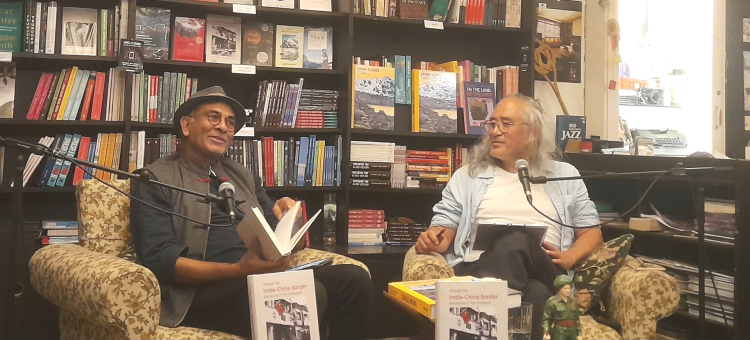
GANGTOK,: Scholar and author Prem Poddar explored Kalimpong’s
layered history, multicultural character and evolving identity during a
discussion on his book “Through the India-China Borders, Kalimpong in the
Himalayas” at Rachna Books here on September 30.
Poddar, who co-authored
the book with Lisa Lindkvist Zhang and was in conversation with journalist and
writer Pema Wangchuk, said the book examines Kalimpong as a town shaped by
trade, migration, borders and encounters among different cultures and
nationalities.
Published by Cambridge
University Press last year, the book took 12 years to write, although the idea
had been developing in Poddar’s mind for nearly three decades.
Wangchuk described the
book as “accessible, witty, empathetic, engaging and entertaining”.
Poddar emphasised the need
to document the histories of smaller towns that often remain outside mainstream
historical narratives. He said towns across the eastern Himalayas, including
Gangtok, could benefit from works that place local histories at the centre.
The discussion examined
the idea of Kalimpong as a “border cosmopolis”, with Poddar drawing comparisons
with Darjeeling and Gangtok. He said Kalimpong acquired a particularly
multicultural character because of its location along historic trade routes.
Recalling his childhood in
10th Mile, Poddar spoke of growing up amid different languages and communities.
He described the experience as a “mish mash-ness” that left a lasting imprint
on his thinking.
“I have lived away for
more than 30 years, there is a distance, but there is also a memorable
association,” he said, reflecting on his continuing connection with Kalimpong.
Poddar also spoke about
the book’s original proposed title, “China in India”, which was rejected by the
publisher as potentially controversial. He said the book developed around
questions of borders, interfaces and how people make sense of political and geographical
divisions.
Kalimpong’s role in
India-China relations, Chinese migration, the displacement and internment of
Chinese people in India following the war, and the remnants of Chinese
communities in the region were among the subjects discussed.
Describing borders as
“cartographies of the mind”, Poddar said they could be provisional and shaped
by colonial histories. He also discussed his interest in the politics of
passports and the construction of nationality and identity around borders.
The town’s linguistic
diversity was another focus. As many as 119 mother tongues have been recorded
in the region, although Poddar said far fewer languages are actively
represented in everyday life today. He attributed the decline partly to the
region’s changing history and rapid globalisation.
“Most transit points are
becoming almost homogeneous in both appearance and nature. Something similar
can be found happening in Kalimpong right now too,” he said.
Poddar also addressed
Kalimpong’s reputation as a “nest of spies”, saying the town’s identity should
not be reduced to espionage and geopolitics despite its historical
international significance.
Discussing Zhang’s
contribution, Poddar said her Chinese background brought a different
perspective to the book. He noted that she was conscious of how certain
discussions could be perceived and that the authors had to find ways to include
critical material while maintaining the work’s scholarly approach.
The book, Poddar said, was
also a personal debt to his hometown. “I at least owe a debt to write a
narrative,” he said, adding that his academic training eventually gave him a
way to bring the idea into book form.
During the
question-and-answer session, Poddar explained the use of “India-China border”
in the title rather than “India-Tibet border”, saying Tibet continues to exist
in historical and mental consciousness but its status as a territorial entity
has been fundamentally altered by China’s claims over Tibet.
The discussion concluded
with Poddar urging aspiring writers to be patient with their ideas, allow them
time to develop, read widely and build their own libraries to strengthen
critical thinking.